REGULATORY ALERT · EPF / PROVIDENT FUND · SEPTEMBER 2026
Published: 17 September 2026
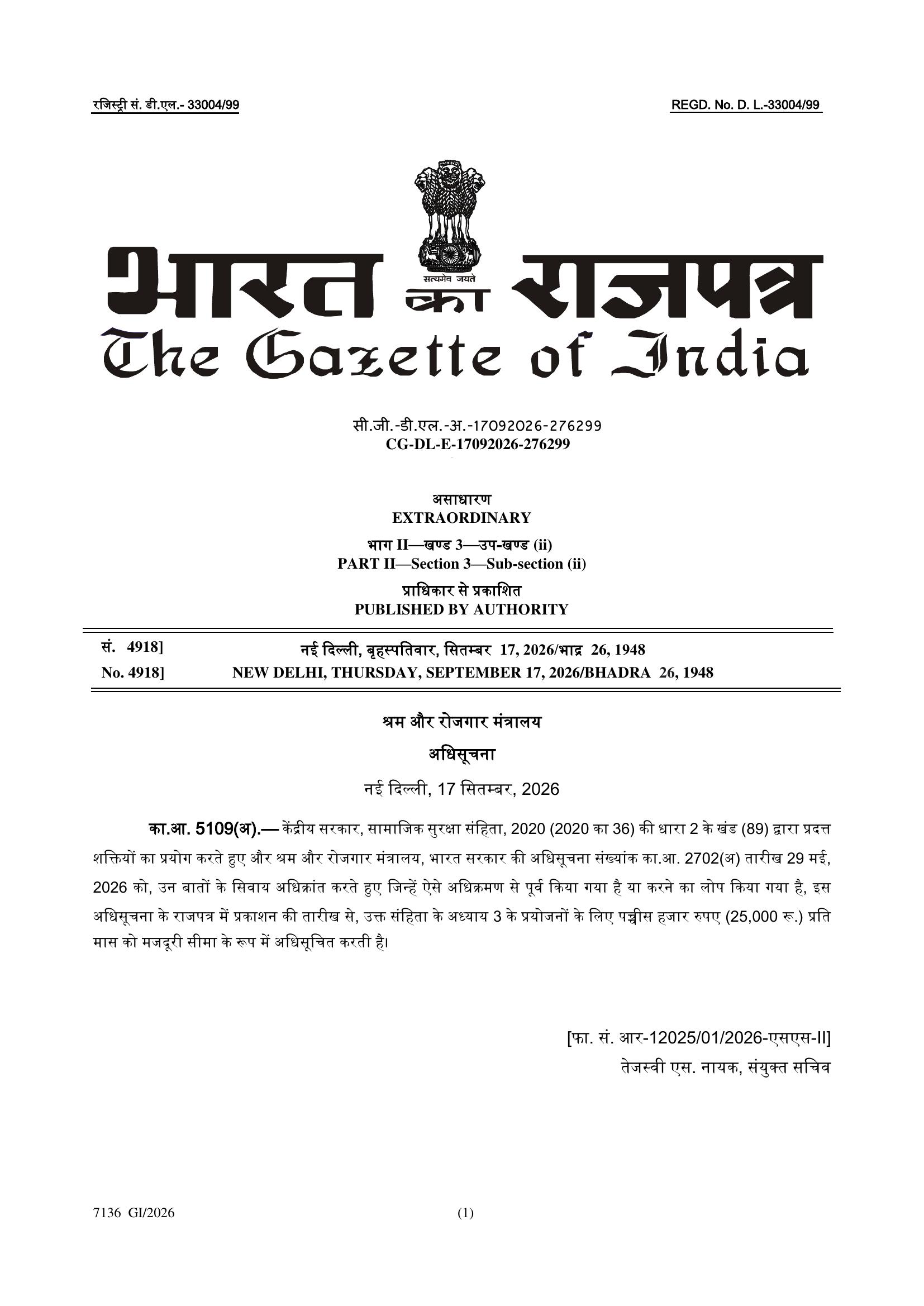
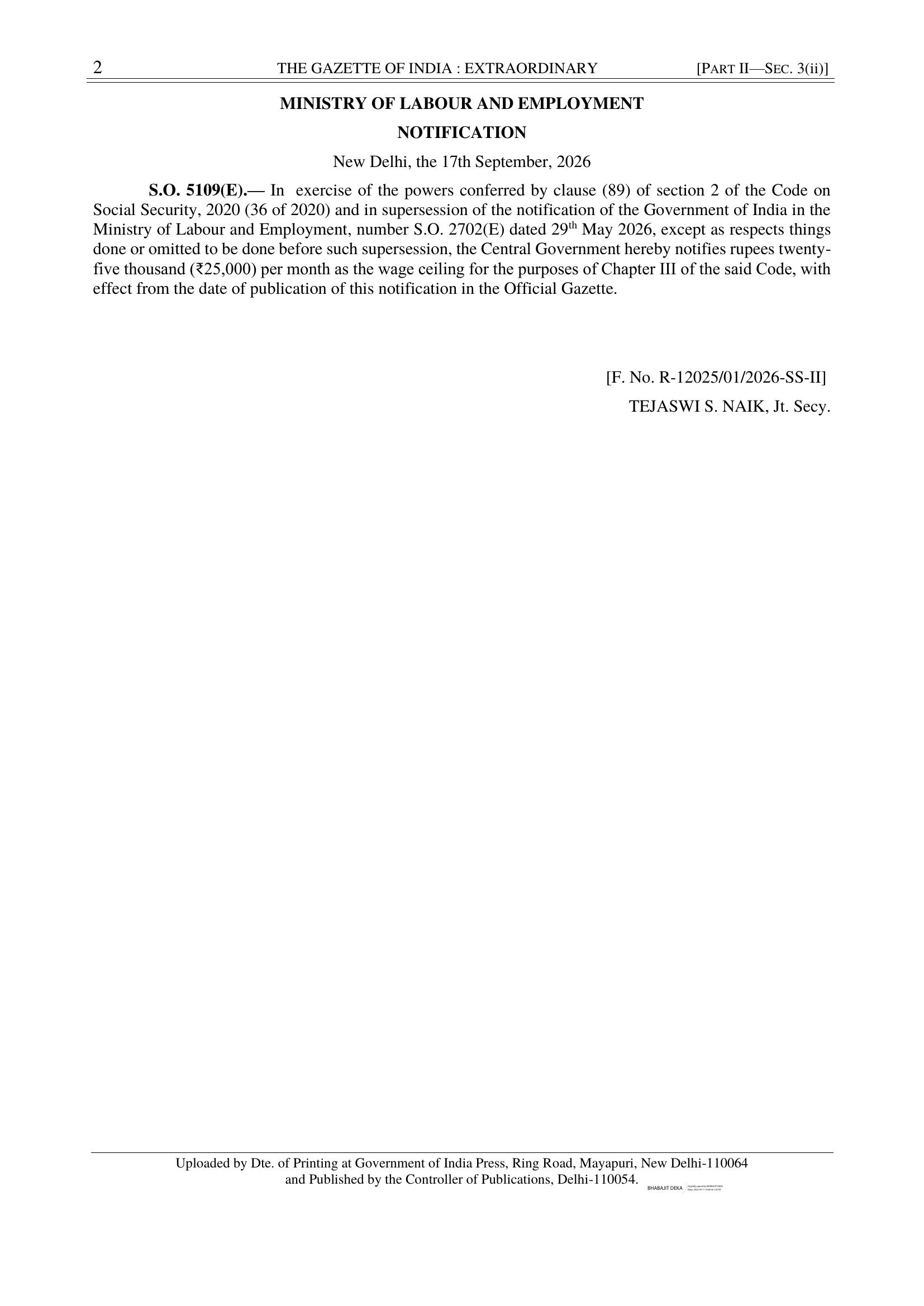
Quick answer: the EPF/EPS/EDLI wage ceiling in India has increased from ₹15,000 to ₹25,000 per month, with effect from 17 September 2026, under Ministry of Labour and Employment notification S.O. 5109(E). The definition of "wages" under Section 2(88) of the Code on Social Security, 2020, and the 50% deeming proviso, are unchanged.
Key Takeaways
- New wage ceiling: ₹25,000 per month for EPF, EPS and EDLI purposes, effective 17 September 2026, under S.O. 5109(E) (supersedes S.O. 2702(E) dated 29 May 2026).
- No change to the "wages" definition: Section 2(88) of the Code on Social Security, 2020, and the 50% deeming proviso are not touched by this notification.
- Quantified impact: employer PF/EPS cost for a fully-capped employee (PF wage ₹30,000) rises by ≈ ₹1,200 per month (≈ ₹14,400 per year) — worked examples inside.
- Compounding effect: the 2026 CTC/wage-code restructuring many corporates carried out now interacts with this higher ceiling, making the real cost impact larger than the ceiling change alone suggests.
- Who is unaffected: employees already drawing wages below ₹15,000, and employees the employer already covers on full uncapped wages.
- Action required: payroll, HR/compensation, finance and legal/compliance teams each have specific to-dos — see Section 8 and how LexComply's GCMS helps in Section 9.
1. Applicability of EPF
1.1 Establishment-level test
- The Employees' Provident Fund (now Chapter III of the Code on Social Security, 2020) applies to every establishment employing 20 or more persons, and to specified classes of establishments notified by the Central Government irrespective of employee count.
- An establishment employing fewer than 20 persons may still be covered voluntarily, by agreement between the employer and a majority of employees, with the Central Government's approval.
- Once an establishment becomes covered, it continues to be covered even if the number of employees subsequently falls below 20 — coverage, once triggered, is not reversed by a later reduction in headcount.
1.2 Employee-level test — the salary/wage criterion
- Within a covered establishment, every employee drawing "PF wages" (basic pay + dearness allowance + retaining allowance, if any — see Section 2 below) up to the notified wage ceiling must be mandatorily enrolled as a PF member from the date of joining.
- An employee whose PF wages exceed the wage ceiling AT THE TIME OF JOINING may be treated as an "excluded employee" — i.e., not mandatorily covered — unless the employer chooses to cover such employees as a matter of policy, or the employee and employer jointly opt for coverage on the excluded employee's actual (uncapped) wages.
- An employee who is already a PF member continues to remain a member even if wages later rise above the ceiling — membership, once acquired, is not lost. Only the CONTRIBUTION BASE may then be capped at the statutory ceiling, unless the employer contributes on the full actual wage as a matter of policy.
- International workers are covered without any wage ceiling (i.e., on full actual wages) unless they hold a Certificate of Coverage under a Social Security Agreement between India and their home country.
- Apprentices engaged under the Apprentices Act, 1961 (and certain other categories specifically excluded by the Scheme) are not treated as "employees" for PF purposes.
- Practical consequence: whether the wage ceiling is ₹15,000 or ₹25,000 does not affect employees already drawing wages below either figure (always covered), nor employees on wages the employer already contributes on without applying any ceiling (already covered on full wage). It matters specifically for the band of employees whose PF wages sit between the old and new ceiling, and for how the contribution base is computed for employees above the new ceiling — see Section 3 for how that figure is calculated, and Sections 4 and 5 for the quantified impact.
2. Definition of "Wages" for PF Purposes
- Under Section 2(88) of the Code on Social Security, 2020, "wages" is defined restrictively: it starts from all remuneration and then excludes specified components, subject to an important deeming proviso (below).
| Included in "wages" (Sec. 2(88)) | Excluded from "wages" (subject to the 50% proviso below) |
|---|---|
| Basic pay | House rent allowance (HRA) |
| Dearness allowance (DA) | Conveyance / travel concession allowance |
| Retaining allowance, if any | Statutory bonus |
| Employer's contribution to PF/pension | |
| Overtime allowance | |
| Commission / conveyance / house accommodation value | |
| Gratuity payable on termination | |
| Retrenchment compensation / other termination/discharge/retirement payments | |
| Any other similar allowance notified by the Central Government |
The 50% deeming proviso
- If the total value of the excluded components listed above exceeds 50% of an employee's total remuneration, the amount in excess of that 50% threshold is added back to "wages" for statutory purposes — including PF contribution.
- Illustration: an employee with total remuneration of ₹1,00,000, of which basic pay + DA is ₹30,000 (30%) and excluded allowances total ₹70,000 (70%), has excluded components exceeding the 50% threshold by ₹20,000. Deemed wages = ₹30,000 + ₹20,000 = ₹50,000 — this higher figure, not the nominal ₹30,000 basic, is what PF (and gratuity) must be computed on, subject to the wage ceiling discussed below.
- This wages definition and the 50% proviso are UNCHANGED by the 17 September 2026 notification. The notification only revises the numerical wage ceiling (see Section 4); it does not touch Section 2(88) or the components/percentage test above.
3. How the ₹25,000 Wage Ceiling Is Calculated — Step-by-Step, With a Worked Example
- The ceiling is not tested against gross salary or CTC. It is tested against a specifically defined figure, "PF wages" under Section 2(88), built up as follows: PF Wages = Basic Pay + DA + Retaining Allowance (if any) + [Excluded components − 50% of total remuneration, if that amount is positive].
- Step 1 — Always-included components: basic pay, dearness allowance (DA), and retaining allowance (if any) count toward PF wages with no threshold test.
- Step 2 — Normally-excluded components: HRA, conveyance/travel concession allowance, statutory bonus, employer's own PF/pension contribution, overtime allowance, commission, house-accommodation value, gratuity, retrenchment/other termination compensation, and any other Central-Government-notified allowance.
- Step 3 — Apply the 50% deeming proviso: if the total of the excluded components in Step 2 exceeds 50% of the employee's total remuneration, the excess over that 50% threshold is added back into "wages." This proviso effectively codifies the Supreme Court's 2019 ruling in RPFC v. Vivekananda Vidyamandir, which held that allowances paid uniformly and necessarily to all employees cannot be dressed up as "special allowance" to avoid PF.
- Step 4 — Compare the resulting PF wages figure to ₹25,000. This test is applied monthly (the ceiling is a per-month figure), and — for deciding whether an employee is mandatorily covered or an "excluded employee" — specifically as at the date of joining (see Section 1.2).
Worked example
- An employee is paid: Basic ₹9,000 + DA ₹3,000 (core wages = ₹12,000), plus HRA ₹4,000, a "special allowance" ₹14,000, and conveyance ₹2,000 (excluded components = ₹20,000). Total remuneration = ₹32,000.
- 50% of total remuneration = ₹16,000. The excluded components (₹20,000) exceed this threshold by ₹4,000 — that ₹4,000 must be added back to wages.
- Deemed PF wages = ₹12,000 (core) + ₹4,000 (add-back) = ₹16,000 — not the nominal ₹12,000 basic + DA.
- Under the OLD ₹15,000 ceiling: ₹16,000 exceeds ₹15,000, so if this were the wage at the time of joining, the employee could have been treated as an "excluded employee" (not mandatorily covered).
- Under the NEW ₹25,000 ceiling: the same ₹16,000 is comfortably within the ceiling, so the employee is mandatorily covered.
- Practical takeaway: because the deeming proviso can pull allowance-heavy pay structures back into "wages," corporates should compute PF wages using the full four-step formula above — not basic + DA at face value — before concluding that an employee sits outside the ceiling.
4. What the 17 September 2026 Notification Changes — and What It Does Not
- Changes: the wage ceiling for Chapter III purposes (EPF, and — since EPS and EDLI contributions are computed as a percentage of the same capped wage — EPS and EDLI as well) moves from ₹15,000 to ₹25,000 per month, with effect from 17 September 2026.
- Does not change: the definition of "wages" itself (Section 2(88)), the 50% deeming proviso, the EPF/EPS/EDLI contribution rates (12% employee, 12% employer, of which 8.33% of the employer's share funds EPS and the balance 3.67% funds EPF; 0.5% employer-funded EDLI), the pension formula (Pensionable Salary × Pensionable Service ÷ 70), or the 20-employee establishment threshold.
- Also unaffected: employees who are "excluded employees" as of 16 September 2026 (i.e., already outside PF because their wages exceeded ₹15,000 when they joined and they were never enrolled) are not automatically pulled into PF merely because their wages now fall below the new ₹25,000 ceiling. Based on how EPFO treated the analogous 2014 ceiling revision (₹6,500 → ₹15,000), such employees typically remain excluded unless the employer/employee jointly opt them in — but this article recommends confirming this specific point against EPFO's implementation circular for the present revision once issued (see Section 7).
5. Impact Analysis — Worked Examples
- The following compares three employees with different PF wages (basic + DA), assuming the employer applies the statutory ceiling as the contribution cap (the common practice). Figures are illustrative arithmetic, not EPFO-published figures.
| Scenario A PF wage ₹12,000 |
Scenario B PF wage ₹20,000 |
Scenario C PF wage ₹30,000 |
|
|---|---|---|---|
| PF wage base — till 16 Sep 2026 (ceiling ₹15,000) | ₹12,000 (below ceiling — no capping) | ₹15,000 (capped — actual wage ₹20,000 exceeds old ceiling) | ₹15,000 (capped — actual wage ₹30,000 exceeds old ceiling) |
| PF wage base — from 17 Sep 2026 (ceiling ₹25,000) | ₹12,000 (still below ceiling — no change) | ₹20,000 (actual wage now fully within new ceiling — cap no longer binds) | ₹25,000 (capped — actual wage ₹30,000 still exceeds new ceiling) |
| Employee contribution (12%) — before / after | ₹1,440 / ₹1,440 — no change | ₹1,800 / ₹2,400 — up ₹600 per month | ₹1,800 / ₹3,000 — up ₹1,200 per month |
| Employer contribution (12%) — before / after | ₹1,440 / ₹1,440 — no change | ₹1,800 / ₹2,400 — up ₹600 per month | ₹1,800 / ₹3,000 — up ₹1,200 per month |
| Annualised employer cost increase (this employee) | Nil | ≈ ₹7,200 / year | ≈ ₹14,400 / year |
Full EPS/EDLI break-up for the highest-impact case (Scenario C)
| Component | Till 16 Sep 2026 (₹15,000 base) | From 17 Sep 2026 (₹25,000 base, Scenario C: PF wage ₹30,000) |
|---|---|---|
| EPS (8.33% of employer's EPF share, capped at wage ceiling) | 8.33% × ₹15,000 ≈ ₹1,250 | 8.33% × ₹25,000 ≈ ₹2,083 |
| EPF (employer's balance, 3.67% of capped wage) | ₹1,800 − ₹1,250 = ₹550 | ₹3,000 − ₹2,083 = ₹917 |
| Total employer EPF+EPS contribution (12% of capped wage) | ₹1,800 | ₹3,000 |
| EDLI contribution (0.5% of wage, employer-funded, capped at wage ceiling) | 0.5% × ₹15,000 = ₹75 | 0.5% × ₹25,000 = ₹125 |
- The ₹1,200 per month (₹14,400 per year) employer-cost increase in Scenario C matches the figure reported in contemporaneous press coverage of this notification, which cross-checks the arithmetic above.
- Employees whose employer already contributes on full actual wages without applying any ceiling see NO change from this notification — they were never subject to the cap.
- Net effect for an affected employee: higher monthly PF/EPS deduction reduces take-home pay, but increases the retirement corpus and — because EPS contribution is now computed on a higher capped wage — the eventual pension under the Pensionable Salary × Pensionable Service ÷ 70 formula.
6. Interaction with the Wage-Code / CTC Restructuring Done Earlier This Year
- Many corporates restructured CTC structures earlier this year to ensure basic pay + DA meets or exceeds roughly 50% of total remuneration, in order to avoid the Section 2(88) deeming proviso inflating "wages" unpredictably. That restructuring exercise addressed the DEFINITION of wages and remains valid and necessary — this notification does not change Section 2(88) or the 50% test, so the restructuring methodology itself does not need to be redone.
- However, the FINANCIAL IMPACT of that restructuring is now materially larger than originally budgeted. Many restructured pay-mixes deliberately raised basic + DA to a figure in the ₹18,000–₹25,000 range for mid-level employees to satisfy the 50% test. Under the old ₹15,000 ceiling, PF was still capped at ₹15,000 regardless of how much higher the restructured basic + DA was. Under the new ₹25,000 ceiling, that same restructured (and now typically higher) basic + DA falls substantially or fully within the mandatory contribution base.
- Practical consequence: the combination of (a) a higher basic + DA from the earlier restructuring and (b) a higher wage ceiling from this notification compounds — the PF cost increase many corporates will see is larger than the ceiling change alone would suggest, because the restructuring already moved more of the pay-mix into the components (basic + DA) that the ceiling now catches more fully.
- Recommended action: corporates should re-run the cost projections prepared during the earlier wage-code restructuring using the new ₹25,000 ceiling, rather than assuming the original projections (based on a ₹15,000 ceiling) still hold. The restructured pay-mix itself does not need to be revisited on account of this notification, but its cost consequence does.
7. Open Items — Points to Confirm via EPFO Circular
- Mid-month effective date: whether September 2026 contributions are apportioned pre-/post-17 September, or the new ceiling applies to the whole of September's wages.
- Treatment of existing "excluded employees" whose wages fall between ₹15,000 and ₹25,000 — whether any option (voluntary or automatic) to join is being offered as part of this revision.
- Interaction with the EPFO higher-pension option (available to certain members under the post-November-2022 Supreme Court framework) for members who had already opted to contribute on wages above the erstwhile ceiling.
- Any transitional guidance for payroll systems and Form-11/UAN onboarding processes reflecting the revised ceiling.
8. Action Points for Corporates
Payroll
- Update payroll master data to reflect the ₹25,000 wage ceiling for PF, EPS and EDLI computation from 17 September 2026.
- Re-run PF, EPS and EDLI contribution computations for all employees whose PF wages fall between ₹15,000 and ₹25,000, and for those above ₹25,000 where the ceiling is applied.
HR / Compensation
- Re-assess CTC cost projections prepared during the earlier wage-code restructuring, factoring in the higher ceiling (see Section 6).
- Identify employees who were "excluded employees" and confirm, once EPFO's circular is available, whether their status changes.
Finance / Budgeting
- Quantify the incremental employer PF/EPS/EDLI cost across the workforce using the Scenario A/B/C methodology in Section 5, and update payroll cost budgets for the current and next financial year.
Legal / Compliance
- Track EPFO's implementation circular for this notification and update internal FAQs/communication to employees on the change in deduction.
- Review employment contracts and offer letters that reference the PF wage ceiling by a specific figure, and update template language to refer to "the statutory wage ceiling as amended from time to time" rather than a fixed number.
- Confirm treatment for new joinees between 17 September 2026 and any EPFO clarification — new employees with PF wages up to ₹25,000 must be enrolled as PF members from date of joining.
9. How LexComply's Global Compliance Management System (GCMS) Helps
- Always-current statutory register: GCMS tracks wage-ceiling and other compliance thresholds (PF, ESI, Bonus, Gratuity, minimum wages) across every state and updates the register the moment a notification like S.O. 5109(E) is issued, so no team has to monitor the Gazette manually.
- Automated task generation: a wage-ceiling change like this one is converted into specific, owner-tagged tasks for Payroll, HR/Compensation, Finance and Legal — matching the four-way action list in Section 8 — with due dates and escalation if a task is missed.
- Multi-entity, multi-location rollout: for group companies with several registered establishments, GCMS ensures the same wage-ceiling update is applied consistently across every entity and location, rather than depending on each site to catch the change independently.
- Document vault with version history: the current notification (S.O. 5109(E)), the superseded notification (S.O. 2702(E)), and a corporate's own compliance notes and advisories are stored together with a full version and audit trail — ready evidence for an internal or statutory audit.
- Obligation mapping, not just alerts: GCMS links each notification to the underlying statutory provision (here, Section 2(88) "wages" and Section 2(89) "wage ceiling" of the Code on Social Security, 2020), so compliance owners see why a change matters, not only that it occurred.
- Management dashboards: real-time visibility into which entities/locations have completed payroll updates for the revised ceiling and which are still pending, so leadership does not have to chase status updates manually.
Frequently Asked Questions
What is the new EPF wage ceiling from September 2026?
₹25,000 per month, for the purposes of Chapter III (Employees' Provident Fund) of the Code on Social Security, 2020, effective from 17 September 2026 under notification S.O. 5109(E). It replaces the earlier ₹15,000 ceiling fixed by S.O. 2702(E) dated 29 May 2026.
How is an employee's wage checked against the ₹25,000 limit — what components are counted?
Not gross salary or CTC — only "PF wages" under Section 2(88): basic pay + DA + retaining allowance (if any), plus any amount added back under the 50% deeming proviso (see Section 3 for the full step-by-step method and a worked example). Components like HRA, conveyance, bonus, overtime, commission and gratuity are excluded from this calculation only so long as, together, they do not exceed 50% of the employee's total remuneration.
Does the notification change the definition of "wages" for PF?
No. Section 2(88) of the Code on Social Security, 2020 — and the 50% deeming proviso within it — are unchanged. The notification only revises the numerical wage ceiling under Section 2(89).
Are EPS and EDLI ceilings also revised, or only the EPF ceiling?
The notification refers to the wage ceiling for "Chapter III" of the Code as a whole. Since EPS and EDLI contributions are both computed as a percentage of the same capped wage under the EPF Scheme 2026 / EPS 2026 / EDLI 2026 framework, the ₹25,000 ceiling applies to EPS and EDLI computations as well, not EPF alone.
Will existing "excluded employees" automatically become PF members now that the ceiling has risen?
Not automatically, based on how EPFO treated the comparable 2014 ceiling revision (₹6,500 to ₹15,000) — an employee already excluded typically stays excluded unless the employer/employee jointly opt them in. This specific point should still be confirmed against EPFO's implementation circular for the present revision once issued.
How does this affect the CTC/wage-code restructuring corporates carried out earlier in 2026?
The restructuring methodology (raising basic + DA to meet the Section 2(88) 50% test) remains valid and does not need to be redone. However, its cost impact is now larger than originally budgeted, because the higher basic + DA set during that restructuring falls more fully within the new, higher ₹25,000 ceiling. Corporates should re-run their cost projections using the revised ceiling.
What is the maximum additional employer cost per employee from this change?
For an employee whose PF wage is at or above ₹25,000 (fully capped both before and after), the employer's EPF+EPS contribution rises from ₹1,800 to ₹3,000 per month — an increase of ₹1,200 per month, or ≈ ₹14,400 per year, per employee. Employees with PF wages below ₹15,000, or already contributing on uncapped actual wages, see no change.
Annexure A: Notification S.O. 5109(E) dated 17 September 2026
- Reproduced below for ready reference alongside this article.
Sources
- S.O. 5109(E) dated 17 September 2026, Ministry of Labour and Employment (primary source; reproduced at Annexure A).
- S.O. 2702(E) dated 29 May 2026, Ministry of Labour and Employment (superseded notification fixing the ₹15,000 ceiling).
- The Code on Social Security, 2020 (36 of 2020), Chapter III and Section 2 (definitions, including clause (88) "wages" and clause (89) "wage ceiling").
- Employees' Provident Funds Scheme, 2026; Employees' Pension Scheme, 2026; Employees' Deposit Linked Insurance Scheme, 2026 — notified 29 June 2026 under the Code, replacing the 1952/1995/1976 schemes respectively.